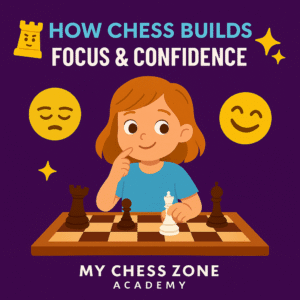
How Chess Builds Focus & Confidence in Kids
Chess is much more than just a board game. It is a powerful developmental activity that improves how children think, make decisions and handle challenges.
Today’s children are surrounded by distractions—screens, phones, games, social media—and most parents worry about low attention span and lack of seriousness. Chess solves these problems in an enjoyable and educational way.
In this article, let’s explore how chess naturally develops focus, confidence, discipline and mental strength—qualities that shape a child’s future success.
⭐ Chess Teaches Children to Stay Focused
Chess is a thinking game. It requires kids to:
-
sit calmly
-
observe carefully
-
think deeply
-
plan ahead
-
avoid mistakes
That means children must use their brain continuously. Slowly, kids automatically learn to stay focused for longer periods.
This is extremely helpful in:
✔ studies
✔ exams
✔ reading
✔ problem solving
✔ school performance
⭐ Chess Improves Attention Span
Children today struggle with short attention span because everything around them is fast and instant.
Chess is slow.
Chess requires patience.
Chess needs continuous thinking.
This trains the brain to stay with one activity for a longer time.
Over months of playing chess, children go from:
❌ 5 minutes focus
to
✔ 45 minutes of undistracted concentration
This improvement is unbelievable for many parents.
⭐ Chess Reduces Screen Addiction
Instead of passive phone scrolling, chess is an active thinking activity. Children are not consuming—children are creating ideas.
Chess gives children a meaningful reason to stay away from screens, gaming, and unnecessary content.
⭐ Chess Improves Memory & Mental Sharpness
Chess strengthens both:
-
short-term memory
-
analytical memory
Kids need to remember:
-
previous moves
-
opponent plans
-
patterns
-
strategies
-
threats
Memory improves naturally without effort.
⭐ Chess Builds Decision-Making Confidence
Many children hesitate while making decisions because they fear being wrong.
Chess teaches:
-
“Take decision”
-
“Think before moving”
-
“Accept mistakes”
-
“Try again proudly”
This life skill builds confidence in:
-
studies
-
sports
-
social interactions
-
problem solving
Strong decision making = strong confidence.
⭐ Chess Makes Kids Responsible for Their Actions
Children quickly learn that every move has consequences.
Wrong move = danger
Good move = reward
They understand:
“I am responsible for my choices.”
This gives them maturity faster than other activities.
⭐ Chess Teaches Discipline and Self-Control
Chess players need self-control to:
-
stay calm
-
avoid rushing
-
ignore distractions
-
think logically
-
follow rules
This develops amazing discipline and behaviour in kids at a very young age.
⭐ Chess Improves Academic Performance
Chess improves:
✔ logic
✔ concentration
✔ comprehension
✔ analysing ability
✔ exam performance
Many parents notice improvement in:
-
Maths
-
Science
-
Reading
-
Memory
Chess literally helps brain development during growing age.
⭐ Chess Builds Confidence Through Achievement
Winning is exciting, but learning from losing is powerful.
Children begin to believe:
-
“I can improve”
-
“I can do difficult things”
-
“I can think better”
-
“I am smart”
This confidence doesn’t come from talk—it comes from real experience.
⭐ Chess Helps Kids Handle Pressure Better
Chess teaches kids to think under pressure during match situations:
-
time pressure
-
attacking pressure
-
defence pressure
-
tournament pressure
Children learn to stay calm and focused instead of getting frustrated.
This is a priceless life skill.
⭐ Chess Teaches Children to Accept Challenges
Most children avoid difficulties.
Chess children LOVE challenges.
They become:
✔ confident
✔ adventurous
✔ problem-solvers
✔ independent thinkers
These qualities help them succeed in life.
⭐ Chess Improves Social Skills
Chess connects kids globally, and helps them meet new friends from different countries.
At My Chess Zone Academy we have international students learning together. Kids develop:
-
global thinking
-
cultural understanding
-
confidence in speaking
Chess makes children smarter socially and mentally.
⭐ Chess Is The BEST Brain Exercise For Kids (Scientifically Proven)
Research shows chess improves:
🧠 memory
🧠 attention
🧠 reasoning
🧠 IQ
🧠 discipline
🧠 creative thinking
No game gives so many benefits at once.
⭐ How Chess Builds Confidence Step-By-Step
✔ learning rules
✔ playing games
✔ solving puzzles
✔ beating mistakes
✔ competing
✔ improving
✔ winning
Every small achievement builds confidence.
⭐ What Age Should Kids Start?
Ideal starting age:
✔ 5–12 years
But even teenagers start and become strong.
⭐ Summary
Chess builds:
-
long attention span
-
independent thinking
-
confidence
-
self-control
-
discipline
-
problem-solving
-
decision-making
Chess prepares children for real life success.
⭐ Book Free Trial Class – Free Trial Class – My Chess Zone
My Chess Zone Academy offers:
✔ kids beginner batches
✔ international coaching
✔ live online training
✔ tournaments
✔ weekly practice
✔ fun interactive sessions
Free Trial Class – My Chess Zone
Best Online Chess Classes for Kids and Beginners (Complete Guide – 2025)
Best Online Chess Classes for Kids and Beginners (Complete Guide – 2025)
How to Improve in Chess (Complete Guide for Kids & Beginners)
How to Improve in Chess (Complete Guide for Kids & Beginners)
Best Online Chess Academy
10 Basic Chess Rules Every Beginner Must Know
Chess for Kids – Beginner Guide
FAQ
Q1. Does chess really improve focus?
Yes, chess forces the brain to concentrate deeply which strengthens focus naturally.
Q2. Will chess improve my child’s confidence?
Yes—chess teaches decision-making and winning through effort.
Q3. At what age should my child learn chess?
5+ is ideal, but any age is good for starting.
Q4. Is online chess effective?
Absolutely, online learning builds deep focus with guided coaching.
Q5. Can my child become strong without tournaments?
Yes, but tournaments make children stronger and more confident.
#kidschess #learnchess #confidenceforkids #focusforkids #chessforkids #mychesszoneacademy #braintraining #smartkids #kidscanchess #chessimprovement #childdevelopment #globalchessacademy #chessforbeginners #onlinechessclasses #internationalchesskids #chesseducation #brainexercise #decisionmaking #increaseconfidence #strengthenfocus #studybetter #focusactivitiesforkids #logicalthinking #criticalthinking #kidslearningonline #bestonlinechessacademy #kidsactivities #parentingtips #usaeducation #ukchess #uaechess #dubai #canadachess #singaporekids #brainpower #globalparents #kidssuccess #futureleaders #chessmotivation #smartchildren #studentsuccess #mindskills #focuschallenge #confidencebuilding #kideducation #chess