Learning chess becomes easy when you understand the basic rules clearly.
Whether you’re a beginner or a parent helping your child start chess, these 10 fundamental rules will help you play confidently and avoid common mistakes.
Let’s explore them one by one 👇
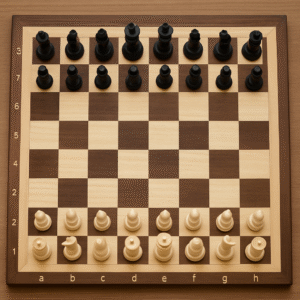
1. White Always Moves First
In every official and casual chess game, White makes the first move.
This rule has existed for more than 150 years and gives White a slight advantage.
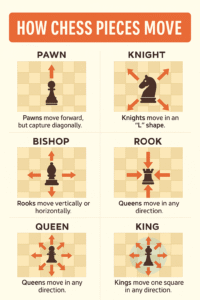
2. Each Piece Moves in a Specific Way
Every chess piece has its own movement pattern:
- Pawn – moves forward, captures diagonally
- Rook – moves in straight lines
- Knight – moves in an L-shape
- Bishop – moves diagonally
- Queen – moves like rook + bishop
- King – moves one square any direction
Knowing how each piece moves is the foundation of chess.
3. You Cannot Move Through Other Pieces (Except the Knight)
All pieces except the knight cannot “jump over” other pieces.
If another piece blocks your path, you must stop before it.
4. You Must Protect Your King at All Times
Your king is the most important piece.
If the king is under threat, it’s called check.
When you are in check, you MUST:
- Move the king
- Block the check
- Capture the attacking piece
You cannot ignore a check.
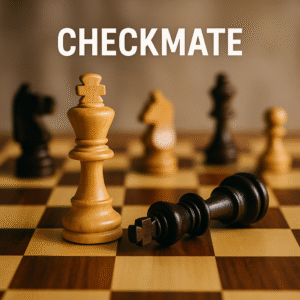
5. Checkmate Ends the Game
A player wins when they put the opponent’s king in checkmate, meaning:
- King is under attack
- Cannot move anywhere safe
- No piece can block
- No piece can capture the attacker
This is the main goal of chess.
6. Stalemate Is a Draw
A game can also end without a winner.
A stalemate happens when:
- The player has NO legal move
- The king is NOT in check
This results in a DRAW.
7. You Can Only Capture One Piece Per Move
Each move can only capture one piece.
You cannot capture two or more pieces in a single move.
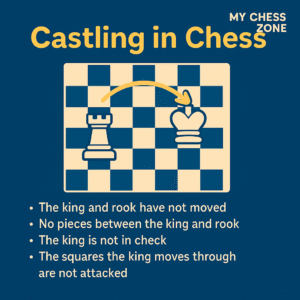
8. Special Rule: Castling
Castling is the ONLY move where two pieces move at the same time (king + rook).
You can castle only if:
- King and rook have NOT moved
- No pieces between them
- King is not in check
- King does not pass through check
Two types of castling:
- Kingside (short)
- Queenside (long)
9. Special Rule: En Passant
En passant is a special pawn capture.
It happens when:
- Opponent moves pawn 2 squares from the starting position
- Your pawn is exactly beside it
- You can capture it as if it moved only 1 square
This move must be done immediately on the next move.
10. Pawn Promotion
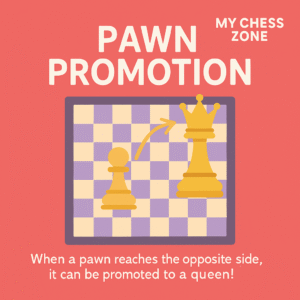
When a pawn reaches the final rank (last row), it must promote to:
- Queen
- Rook
- Bishop
- Knight
Most players choose Queen because it’s the strongest.
This rule helps beginners understand how powerful pawns can be.
🌟 Bonus Rule: Touch-Move Rule
In tournaments, if you touch a piece, you must move it (if legal).
If you touch an opponent’s piece, you must capture it (if legal).
📝 Conclusion
These 10 rules are the foundation of chess.
If you follow them correctly, your understanding and confidence will grow quickly.
Learning chess is one of the best ways for kids to improve:
✔ Memory
✔ Focus
✔ Imagination
✔ Problem solving
✔ Patience
If your child wants to learn chess with expert coaches:
👉 Book your FREE trial today: – Click the link below:
Free Trial Class – My Chess Zone
If you are new to chess, don’t miss our more learning blogs!
Best Age for Kids to Start Learning Chess
How to Choose the Best Online Chess Academy for Your Child
Top 10 Signs Your Child Will Become Good at Chess
Online Chess vs Offline Chess Classes: Which is Better for Kids?
Online Chess vs Offline Chess Classes: Which is Better for Kids?
How Many Hours Should Kids Practice Chess Daily?
#chess #bestchessacademy #learnchessonline #chessforbeginners #kidschess #onlinechess #ChessKidsUSA #chessskills #chessforkids #onlinechessclasses #chesscoaching #chesscoachonline #professionalchesscoaching #kidseducationonline #globalchessacademy #onlinechessforkids #chesspractice #chesslearning #kidsbraintraining #skillbuildingforkids #chesseducationonline #USAparents #parentschoice #topratedacademy #chesscourse #chessstudents #chessimprovementjourney #onlinelearningUSA #myChessZoneAcademy #playchessonline