Beginner Chess Tips for Kids (Easy Guide for Parents and Young Learners)
Chess is one of the best activities a child can learn at an early age. It improves thinking, concentration, confidence and planning. But most children start chess without understanding some simple concepts that make learning easier. This guide gives practical beginner-friendly chess tips to help kids learn faster and enjoy the game more.
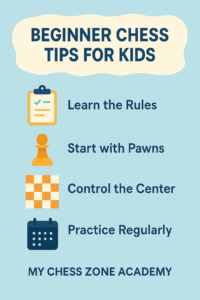
⭐ Tip #1 – Learn How Each Piece Moves
The most important beginner step is understanding how every piece moves. Teach slowly:
-
pawn moves forward
-
knight jumps
-
rook moves in straight lines
-
bishop moves diagonally
-
queen moves anywhere
-
king moves one square
Understanding this clearly makes progress much easier.
⭐ Tip #2 – Use Puzzles Every Day
Chess puzzles help kids:
-
recognize patterns
-
see tactics
-
understand checkmates
-
improve calculation
Start with 1-move puzzles, then slowly move to 2-3 move puzzles later.
⭐ Tip #3 – Always Protect the King
Many beginners forget to keep their king safe. Teach them:
-
castle early
-
do not open the king too soon
-
avoid moving the same piece again and again
Kid-friendly version:
“The king must remain safe inside his castle.”
⭐ Tip #4 – Develop Your Pieces Early
Beginners often move pawns too much and forget to use pieces. Teach them:
-
knight out
-
bishop out
-
castle
-
control center
This creates a strong foundation early in the game.
⭐ Tip #5 – Think Before Every Move
Teach kids to ask ONE question:
“What is my opponent trying to do?”
This simple habit prevents blunders and teaches real chess thinking.
⭐ Tip #6 – Don’t Attack Without a Plan
Most beginners attack randomly. Instead:
-
develop pieces first
-
bring king to safety
-
connect rooks
-
only then look for attacks
⭐ Tip #7 – Learn Tactical Patterns Early
Beginner tactics include:
-
fork
-
pin
-
skewer
-
double attack
-
checkmate patterns
Kids love learning tactical tricks and winning quickly!
⭐ Tip #8 – Don’t Try To Memorize Opening Moves
Memorizing moves will not help beginners. Instead learn:
-
opening rules
-
principles
-
center control
Examples:
-
develop pieces
-
castle early
-
don’t move queen too early
⭐ Tip #9 – Practice Short Mini Games
Small mini games help beginners learn faster than full games:
-
queen vs king
-
rook vs king
-
knight catching pawns
-
king and rook checkmate
Each mini-game teaches useful ideas.
⭐ Tip #10 – Play Regularly
Kids must play daily, not once a week. Even 15 minutes per day helps:
-
10 mins puzzles
-
5 mins game
-
5 mins review
Consistency builds confidence.
⭐ Tip #11 – Learn From Your Mistakes
After each game:
-
find what mistake happened
-
learn one improvement
-
don’t repeat the same mistake
Gaming without learning does NOT create chess improvement.
⭐ Tip #12 – Learn Checkmate Patterns
Kids should know:
-
checkmate with queen
-
checkmate with rook
-
simple checkmates
Celebrate every checkmate—it keeps them excited!
⭐ Final Message for Parents
Chess gives children much more than game skills. It teaches discipline, respect, patience, confidence and logic. With the right training, every beginner can become a strong chess thinker!
🟦 BOOK FREE TRIAL CLASS (CALL TO ACTION)
👶 Want your child to learn beginner chess in a fun way?
📩 Join My Chess Zone Academy Today
 Book your FREE trial today:
Free Trial Class – My Chess Zone
🟨 5 FAQs FOR SEO
Q1. What is the best beginner tip for kids?
Start with simple movements and teach children how each piece works step by step.
Q2. How long does it take to learn chess basics?
Most kids learn basic moves within 2–4 weeks if regular.
Q3. Should beginners learn openings first?
No. Beginners should learn tactics and basic rules before openings.
Q4. Which is best—online or offline learning?
Both are good. Online is flexible, affordable and easier for beginners.
Q5. How do beginners avoid blunders?
By asking “What is my opponent trying to do?” before playing a move.
#BeginnerChess #ChessForKids #KidsChess #ChessLearning #ChessPractice #LearnChessOnline #ChessClassesKids #ChessBeginners #ChessEducation #ChessAcademy #OnlineChessClasses #ChessUSA #ChessUK #ChessCanada #ChessSingapore #ChessDubai #ChessAustralia #ChessIndia #ChessTraining #ChessCoach #ChessKids #KidsOnlineLearning #ChessCommunity #ChessWorldwide #ChessLife #ChessStudents #ChessTips #ChessStrategy #ChessTactics #ChessMindset #ChessImprovement #ChessLessons #BeginnerChessKids #KidsChessOnline #ChessWorld #ChessLearningJourney #ChessActivities #ChessConfidence #ChessBasics #ChessParents #ChessSmartKids #ChessStudy #LearnChessEffectively #ChessFunForKids #ChessTeaching #ChessInspiration #chess
Learn More:
The Best Chess Academy — Online AND Offline
Why Parents Trust My Chess Zone Academy
How to Play Chess for Complete Beginners — Step by Step Guide Blog 1
How to Play Chess for Complete Beginners — Step by Step Guide Blog 1
Top 10 Basic Chess Rules Every New Player Must Know – Step by Step Guide Blog 2
Top 10 Basic Chess Rules Every New Player Must Know – Step by Step Guide Blog 2
Best Chess Openings for Beginners (Easy to Learn)
Book your FREE trial today:
Free Trial Class – My Chess Zone